

The Market That Stopped Believing in Wolves
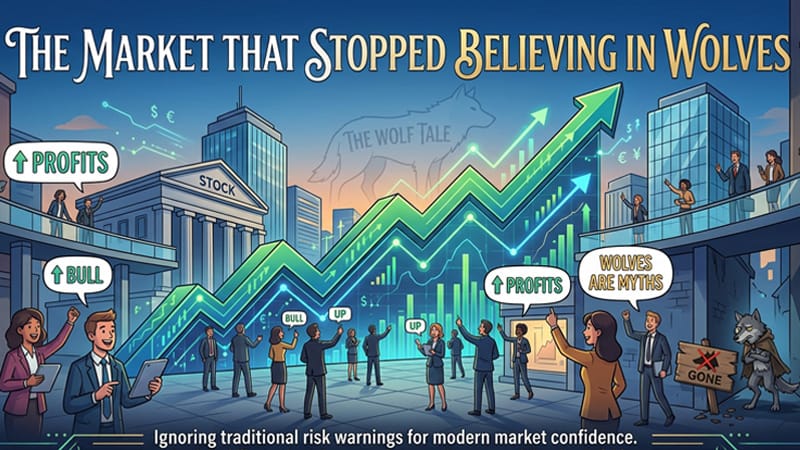
Why Investors Should Stay Invested — Without Becoming Complacent
Markets in 2026 have faced no shortage of reasons for investors to worry: persistent inflation concerns, uncertainty around interest rates, geopolitical conflicts, government deficits, tariffs and questions about slowing economic growth. Yet despite repeated warnings that one of these risks could trigger a significant market correction, markets have continued to demonstrate remarkable resilience.
For investors who reduced their equity exposure, raised cash or purchased downside protection, this environment has often been frustrating. Markets have repeatedly recovered from periods of weakness, while investors who simply remained invested have generally been rewarded.
This raises an important question: If markets continually ignore bad news, should investors learn to ignore it as well?
The article The Market That Stopped Believing in Wolves argues that the answer is no. Instead, investors need to distinguish between reacting emotionally to every warning and maintaining a disciplined strategy for responding when the evidence genuinely changes.
The “Boy Who Cried Wolf” Market
The article uses the familiar story of The Boy Who Cried Wolf as an analogy for today’s investment environment.
Every time investors hear a new warning, they initially become concerned. They may sell equities, increase cash or purchase protection. But when the anticipated market decline fails to materialize—or markets quickly recover—the cost of being cautious becomes increasingly apparent.
Over time, investors become conditioned to respond differently:
A new risk appears. Markets initially decline. The feared crisis fails to develop. Markets recover. Investors who sold or hedged underperform. The next time a warning appears, investors are less inclined to react.
Eventually, “buy the dip” becomes almost instinctive.
This behaviour can create complacency. The wolf may have failed to appear the first nine times, but that does not mean the tenth warning should automatically be ignored.
A Beautiful Mind and Investor Behaviour
The article connects this behaviour to John Nash and the concept of a Nash equilibrium, popularized through the movie A Beautiful Mind.
In simple terms, our best decision often depends not only on what we believe, but also on what we expect everyone else to do.
Consider an investor who believes stocks are expensive and economic risks are increasing. Normally, that investor might reduce equity exposure. However, they also observe several powerful forces supporting markets:
- Retail investors continue buying market declines.
- Retirement and passive investment contributions continue flowing into equities.
- Professional managers risk underperforming their benchmarks if they hold too much cash.
- Investors expect central banks or governments to intervene if financial conditions deteriorate significantly.
- Investors who sold during previous scares have frequently watched markets recover without them.
As a result, investors may remain invested even when they are uncomfortable—not because they believe everything is fine, but because they believe other investors are unlikely to sell.
This creates a type of market equilibrium: nobody wants to leave the party first because leaving too early can be expensive.
The Cost of Being Too Cautious
Risk management is important, but protection has a price.
Holding excessive cash during a rising market creates an opportunity cost. Hedging strategies can expire without providing a benefit. Defensive investments can significantly lag equities when markets continue higher.
An investor can therefore correctly identify a legitimate long-term risk and still lose money by preparing for it too early, too aggressively or for too long.
The challenge is particularly noticeable when broad markets are rising strongly. Any decision that reduces market participation—whether through cash, hedging, defensive positioning or simply avoiding the market’s strongest-performing companies—creates a performance hurdle that must eventually be overcome.
Sometimes doing nothing can be the most profitable decision.
But that does not mean doing nothing will always be the right decision.
The Cost of Being Wrong Is Not Equal
One of the article’s most important observations is that investment mistakes have different consequences.
Preparing for a market decline that never arrives has a cost. Investors may sacrifice returns, incur hedging expenses or miss part of a market rally.
However, ignoring a genuine threat can potentially be much more damaging.
A 50% portfolio decline requires a 100% return simply to get back to where the investor started. For retirees withdrawing from their portfolios—or investors who panic and sell after markets have already declined—the damage can be even more difficult to recover from.
The objective, therefore, should not be to react to every warning. Nor should investors become so accustomed to false alarms that they ignore genuine evidence of deteriorating conditions.
The challenge is finding the balance between paranoia and complacency.
Stable Markets Can Still Be Fragile
Repeated market recoveries can actually change investor behaviour.
As confidence increases that every market decline will be temporary, investors may hold less cash, reduce hedges, increase exposure to investments that have recently performed well and become increasingly dependent on the assumption that other investors will continue buying market declines.
None of these conditions guarantees a market crash.
However, they can make markets more vulnerable if something eventually changes investor expectations.
The critical question may no longer be simply, “Is this news bad?”
Instead, it becomes, “Will everyone else now believe this news is bad enough to sell?”
If that perception changes, a stable market can become unstable surprisingly quickly. Investors who were comfortable holding yesterday may suddenly decide to sell today because they expect everyone else to sell tomorrow.
Prediction vs. Preparation
The article’s central lesson is not that investors should become more defensive. It is that they should become more disciplined.
There is an important difference between prediction and reaction.
Prediction requires believing that we can identify exactly which event will cause markets to decline, when it will happen and how severe the decline will be.
A disciplined reaction acknowledges that we cannot reliably predict these things. Instead, investors determine in advance what evidence would justify changing their portfolio risk.
That might include monitoring whether economic weakness is spreading, inflation is limiting central-bank flexibility, liquidity conditions are deteriorating, credit markets are showing signs of stress or market trends have materially weakened.
Headlines can provide useful information, but they should not dictate an investment strategy.
Winning by Not Losing
The lesson from 2026 so far is that investors who remained invested have generally been rewarded compared with those who repeatedly prepared for a major decline that never arrived.
That lesson is worth remembering—but it should not be taken too far.
Bad news has not become irrelevant. Market risk has not disappeared. And the fact that previous warnings were premature does not mean future warnings will also prove harmless.
The better strategy is to remain invested while the evidence supports remaining invested, while maintaining clearly defined risk thresholds that determine when action should be taken.
Think of equities as the fast lane on a highway. Exiting every time dark clouds appear can leave investors far behind when the storm never arrives. But experiencing several sunny days does not mean we should remove the brakes from the car.
Successful investing therefore requires being prediction-light but preparation-heavy.
We do not need to know precisely when the wolf will arrive. We need a disciplined process that allows us to participate when markets remain healthy, recognize when conditions are genuinely changing, and respond before one major loss permanently damages the financial plan.
The greatest danger may come when ignoring risk no longer feels risky at all—but instead begins to feel completely rational.
Read the full article:
The Market That Stopped Believing in Wolves — What A Beautiful Mind, a frightened shepherd boy, and a costly year for caution can teach us about market risk.
Posted in The Francis Forum